

July 24, 2008

A visit to Chanticleer: Cut Flower & Vegetable Garden

Filed under: 7th Year--2008, Garden tours 2008 — Pam/Digging @ 5:08 am


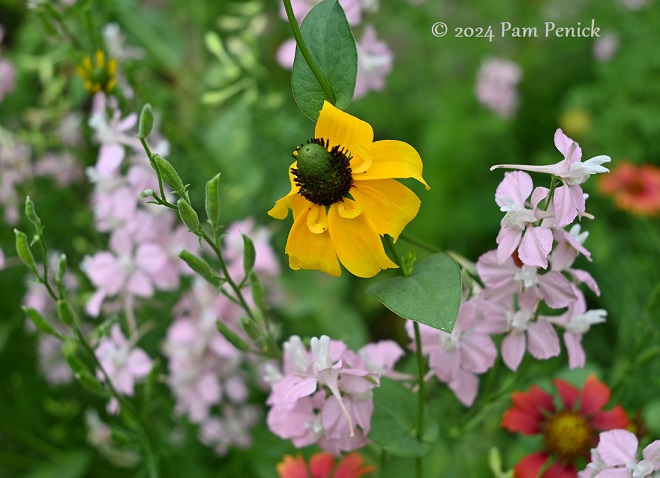
Our final stop on our early July visit to Chanticleer was the Cut Flower & Vegetable Garden. How sweet, green, and lush it appeared—like an April garden in Austin. Old-fashioned lovelies like hollyhocks (above) and sunflowers gave height to the rows of cutting flowers.


Bent-twig arches also provided height and structure.


I adored this sweep of pink yarrow.


A closer look


Sea holly is one of those dramatic plants I keep meaning to find a place for in my own garden. The silvery blue foliage and flowerheads are fantastic.


This dragonfly took a rest on one of the arches above our heads, holding still for a silhouetted snapshot.


At one end, a picket-fenced potager is entered through an archway of weeping blue atlas cedar (if my ID is correct).


Inside you find a working vegetable garden.


Here too is a picturesque garden shed, outfitted with window boxes and working shutters—even a brick chimney.


I deeply enjoyed my visit to Chanticleer and hope to visit again one day—perhaps in spring, when rivers of bulbs are in bloom in the orchard and along the stream banks.


Until then, I’ll be strolling the paths and sitting in these chairs in my memory.

For a look back at the Ruin and Gravel Garden, click here. Thanks for joining me on my virtual tour of Chanticleer.

All material © 2006-2008 by Pam Penick for Digging. Unauthorized reproduction prohibited.

July 23, 2008

A visit to Chanticleer: Ruin & Gravel Garden

Filed under: 7th Year--2008, Garden tours 2008 — Pam/Digging @ 5:12 am


Among all the beautiful, bold, and imaginative gardens at Chanticleer, why do I like the Ruin and Gravel Garden best? It so resembles the dry gardens of west Austin that I feel a little sheepish to admit that in this lush, Pennsylvania garden I preferred the familiarity of home. But home jazzed up, a strangely lush Hill Country-esque tapestry, with the surprising backdrop of tall eastern hardwoods and conical junipers to remind me I’m actually far from home. Perhaps it was also the novelty of seeing the vernacular of home—yuccas and agaves, wildflowers, stone and gravel, low-growing xeric plants mixed with feathery grasses—in an unlikely place.


Since Pennsylvania does not share the arid climate of central Texas, this garden of drought-tolerant plants, many of which will not tolerate wet feet, is planted on a slope and mulched with gravel.


Here’s what I haven’t managed in my clay-based, flat garden—lavender. They grow it in the Hill Country, however, and this reminded me of the herb farms in Fredericksburg.


Coneflowers and agaves look great together.


Another view of the raised bed.


A stone-slab bench is a natural in a gravel garden.


Mexican feathergrass provides texture and movement.


Magenta winecups add jewel-toned color to a pairing of agave and ‘Angelina’ sedum.


Stone-slab steps lead up the steep slope…


…and through the xeric (drought-tolerant) garden at top.


A gravel-and-stone path curves toward a shady seating area.


This circular lawn marks the end of the Gravel Garden and offers a place to pause before heading into the Ruin, an 8-year-old structure designed to look like the ruins of an old house at the top of the hill.


Here is where the extraordinary creativity and fancy of the staff is focused. Although the Ruin has a solemn feel, that solemnity is slyly tweaked around every corner. Stone “books” lay scattered on the “library” floor, the furniture (a great stone sofa and chair) have been moved “out of doors,” and this shallow black pool, raised up like a table, stands in for a formal dining table, it seemed to me.


At the far end, a fireplace is topped by a living mantlepiece.


A closer look


In another “room”—open, like the rest, to the sky—oak seedlings sprout among giant, sculpted acorns and oak leaves.


Although they are smiling, I found these marble faces “floating” in another pool fairly creepy.


I didn’t get a good shot of the Ruin itself, only some of the interior. Ah well. It’ll give you yet another reason to see it for yourself. As you head down the hill, you may notice one more face sleeping, like Rip Van Winkle, among sedges and vines.

Come back tomorrow for my final Chanticleer images—the Cut Flower and Vegetable Garden. For pics of the Pond Garden, click here.

All material © 2006-2008 by Pam Penick for Digging. Unauthorized reproduction prohibited.

July 22, 2008

A visit to Chanticleer: Pond Garden

Filed under: 7th Year--2008, Garden tours 2008 — Pam/Digging @ 12:09 pm


The Pond Garden at Chanticleer lies at the bottom of a steep hill in a wide, open space backed by a stand of trees. Though manmade, it look completely natural thanks to its setting and the coarse plantings around its edge.


Here’s an overlook of the Pond Garden. At the middle left, you’ll see the orange daylilies at the edge of the woods, which I showed up close in my earlier post.


The lotuses were in bloom, but unlike this photographer, I neglected to get a single photo. Drat!


Along the edge, golden flowers and foliage added to the sunshiney atmosphere of the pond garden. I’m always happy to see coneflowers.


But I love this variegated pond grass too. Look how the yellow-green chair coordinates with the yellow and green stripes of the plants it overlooks. The staff seem to have thought through every detail.


Purple irises contrast beautifully with the chartreuse foliage in the background.


Climbing the steep hill above the pond, you are rewarded with an overlook of both the pond and the Serpentine. Their website describes it better than I could: “a serpentine avenue of young junipers, banded by wheat and barley, winds up to an almost pagan semi-circle backed by upright gingko trees—a marriage of stone and wood, dedicated to Flora.”


A spin on the alien-designed crop circle?

Next up—the Gravel Garden. Click here for the Asian Woods & Stream Garden.

All material © 2006-2008 by Pam Penick for Digging. Unauthorized reproduction prohibited.

A visit to Chanticleer: Asian Woods & Stream Garden

Filed under: 7th Year--2008, Garden tours 2008 — Pam/Digging @ 5:02 am


During our tour of Chanticleer in early July, the mistiness of early afternoon gave way to bright sunshine as we dipped into the Asian Woods garden below the main house. Tall trees, their lower trunks wrapped in wire trellises for climbing vines, create a serene wood and lead to a winding stream, its banks sheltered by umbrella-sized leaves except for a secret sitting area hidden around a bend.


Mystery. Seclusion. Tranquillity.


“While most of the plants in this garden are native to Korea, Japan, and China, the design style is of an American woodland garden,” explains Chanticleer’s website.


The naturalistic design was a pleasant contrast to the formality of the House Garden we’d just seen.


Tucked here and there among the trees, unique seating areas offer plenty of opportunities to just sit and admire the view.


Here’s another painted chair, this time with a bamboo design that echoes the bamboo grove behind it.


Even the restrooms, built to resemble a Japanese garden house, are lovely.


In this garden and the nearby Stream Garden, what really caught my eye were the path designs, like this one—a starburst made of stone that makes you stop to look around in a small glade.


I think this “paved” area is constructed from pieces of wood laid on edge. I love the effect.


Here’s another path that leads you inexorably onward with a railroad effect.


A closer look


And my favorite—a spiral that expands outward to touch a stone bench tucked among the ferns.


Between the Asian Woods and the Pond Garden, you emerge from the woodland into a sunny space edged with orange daylilies.


They dance under leggy, sheltering bamboo—a unique combination to my eyes.

Later today—the Pond Garden. Click here for a look at Chanticleer’s hydrangeas and the House Garden.

All material © 2006-2008 by Pam Penick for Digging. Unauthorized reproduction prohibited.

Older Posts »

Powered by WordPress
All material © 2006-2008 Pamela Penick. Unauthorized reproduction prohibited.